QWERTY
Layer activators · Keysets
Layer activators
shift_rightshift_leftKeysets
QWERTY is the dominant letter arrangement for English-language keyboards, named after the first six letters of its upper letter row. It took shape during the development of Christopher Latham Sholes’s typewriter in the nineteenth century. Once manufacturers and typists adopted the arrangement, it survived changes to the machinery beneath the keys and the transition to computer keyboards.1, 2
Development
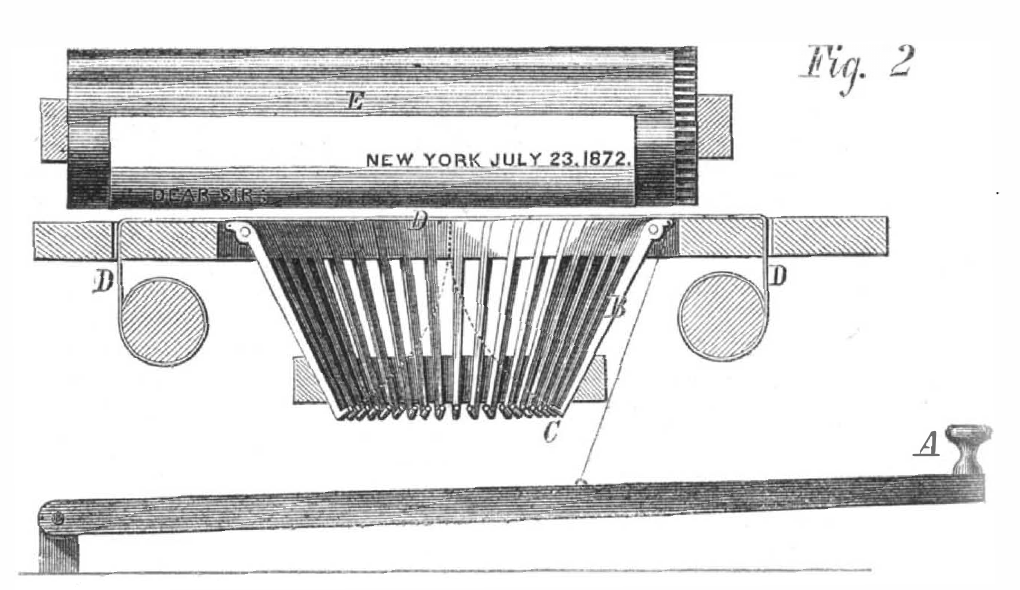
Section titled “Development”The familiar keyboard emerged through several revisions. Sholes and his collaborators Carlos Glidden and Samuel W. Soulé patented a machine with piano-like keys in 1868. By 1872, Scientific American showed four rows of button-like keys and a recognizable predecessor of QWERTY, although R was still on the bottom row. The keyboard was taking its familiar form while the machine itself was still experimental.3, 4
Remington brought the Sholes & Glidden Type-Writer to market in 1874. It printed capitals only. The Remington No. 2 added case shifting in 1878, allowing the operator to print both capitals and lowercase letters with the same keys and typebars. Byron A. Brooks’s patent describes how moving the platen selected one of two characters on each bar, expanding what the machine could print without duplicating its keyboard.1, 5
Later improvements changed what the operator could see as well as what the machine could print. The Underwood No. 5, introduced in 1901, placed its typebars in a front-strike arc so that the text was visible as it appeared. It retained the familiar QWERTY keys, even though their connections to the new mechanism produced a different typebar order from the Remington No. 7’s circular basket.6, 7
Letter arrangement
Section titled “Letter arrangement”A common misconception is that QWERTY was designed to slow typists down to prevent jams. Yet the 1872 Scientific American account advertised fast typing, and Sholes’s later correspondence shows that he valued speed.4, 8
Neil Kay proposes that the arrangement reduced interference by making neighboring typebars correspond to infrequent letter pairs. On early QWERTY machines, a keystroke swung a typebar upward from a circular basket to a common printing point beneath the paper. Rapid successive strokes could bring bars into one another’s path. Levers and wires connected the rows of keys to the basket, so neighboring keys did not necessarily operate neighboring typebars.9, 4, 10
Kay’s illustrative diagram shows the later Remington No. 7 (1896), rather than Sholes’s original prototypes.9 The typebar order changed with the machine. In Koichi and Motoko Yasuoka’s diagram of a Sholes & Glidden, the 5 typebar separates E and R, while E and D are not neighbors. Kay’s Underwood No. 5 comparison places E and D next to one another in the sequence XED.11, 7
The Yasuokas propose another influence: early telegraph transcription, with some key positions chosen to help resolve ambiguities in American Morse.12
Surviving contemporary accounts do not establish the exact reasons for the letter positions.
Adoption
Section titled “Adoption”By the mid-1890s, the US typewriter industry was converging on QWERTY. Between 1895 and 1905, major manufacturers of machines without typebars also offered it. The arrangement had acquired value beyond its connection to one printing mechanism.2
In economist Paul A. David’s 1985 account, widely available QWERTY machines encouraged typists to learn the arrangement, while trained typists gave manufacturers a reason to retain it. A new machine could then use existing skills; a new arrangement required users to learn again. This relationship made QWERTY a prominent example of path dependence: the influence of earlier choices on later outcomes.2
QWERTY remains the familiar reference point for alternatives such as Dvorak and Colemak.
Footnotes
Section titled “Footnotes”-
Virtual Typewriter Museum, “Sholes Glidden (Perfected)”, machine no. 4127 and accompanying historical catalog illustrations; Heinz Nixdorf MuseumsForum, “Typewriters – From the idea to a standard”. ↩ ↩2
-
Paul A. David, “Clio and the Economics of QWERTY,” American Economic Review 75, no. 2 (1985), pp. 332–337, especially pp. 334–336. ↩ ↩2 ↩3
-
Sholes, Glidden, and Soulé, US 79,265, Improvement in type-writing machines, June 23, 1868, specification p. 1, figs. 1, 5, and 7. ↩
-
“The Type Writer,” Scientific American 27, no. 6, August 10, 1872, p. 79, main engraving, fig. 2, and accompanying text. The volume page is 79, although the article occupies the issue’s first page. ↩ ↩2 ↩3
-
Byron A. Brooks, US 202,923, Improvement in type-writing machines, April 30, 1878, specification p. 1 and figs. 3–4. For the No. 2’s introduction, see the Heinz Nixdorf MuseumsForum account. ↩
-
Heinz Nixdorf MuseumsForum, “Typewriters – From the idea to a standard,” section “Underwood No. 1”. ↩
-
Neil M. Kay, The QWERTY Problem, DRUID conference paper, June 17–19, 2013, pp. 9–13. The link supplies the published text through Scribd; the comparison identifies the No. 5, not the first date of that typebar ordering. ↩ ↩2
-
Craig S. Galbraith and Neil Kay, “Hidden in plain sight: QWERTY, the search for optimality and IP complementarity”, Business History 67, no. 8 (2025), pp. 2209–2231; open accepted manuscript, pp. 8–11 (correspondence and speed). Letters are cited through the authors’ transcriptions. ↩
-
Neil M. Kay, QWERTY and the Search for Optimality, Strathclyde Discussion Papers in Economics 13-24 (2013), pp. 4–8 and fig. 1. ↩ ↩2
-
C. Latham Sholes, US 207,559, Improvement in type-writing machines, filed March 8, 1875, granted August 27, 1878; drawing sheet 2, figs. 2–3, and specification p. 2. ↩
-
Koichi Yasuoka and Motoko Yasuoka, “On the Prehistory of QWERTY,” ZINBUN 42 (2011), pp. 170–171, fig. 11 and table 1. ↩
-
Yasuoka and Yasuoka, “On the Prehistory of QWERTY”, pp. 162–164, figs. 1–4 and footnote 1. The journal volume is labeled 2009/2010; the paper was published in 2011. ↩